
Goat Vision: More Than Meets the Eye
Thank you to Cathy Cheng, Associate Professor, Indiana University School of Optometry for her insights!
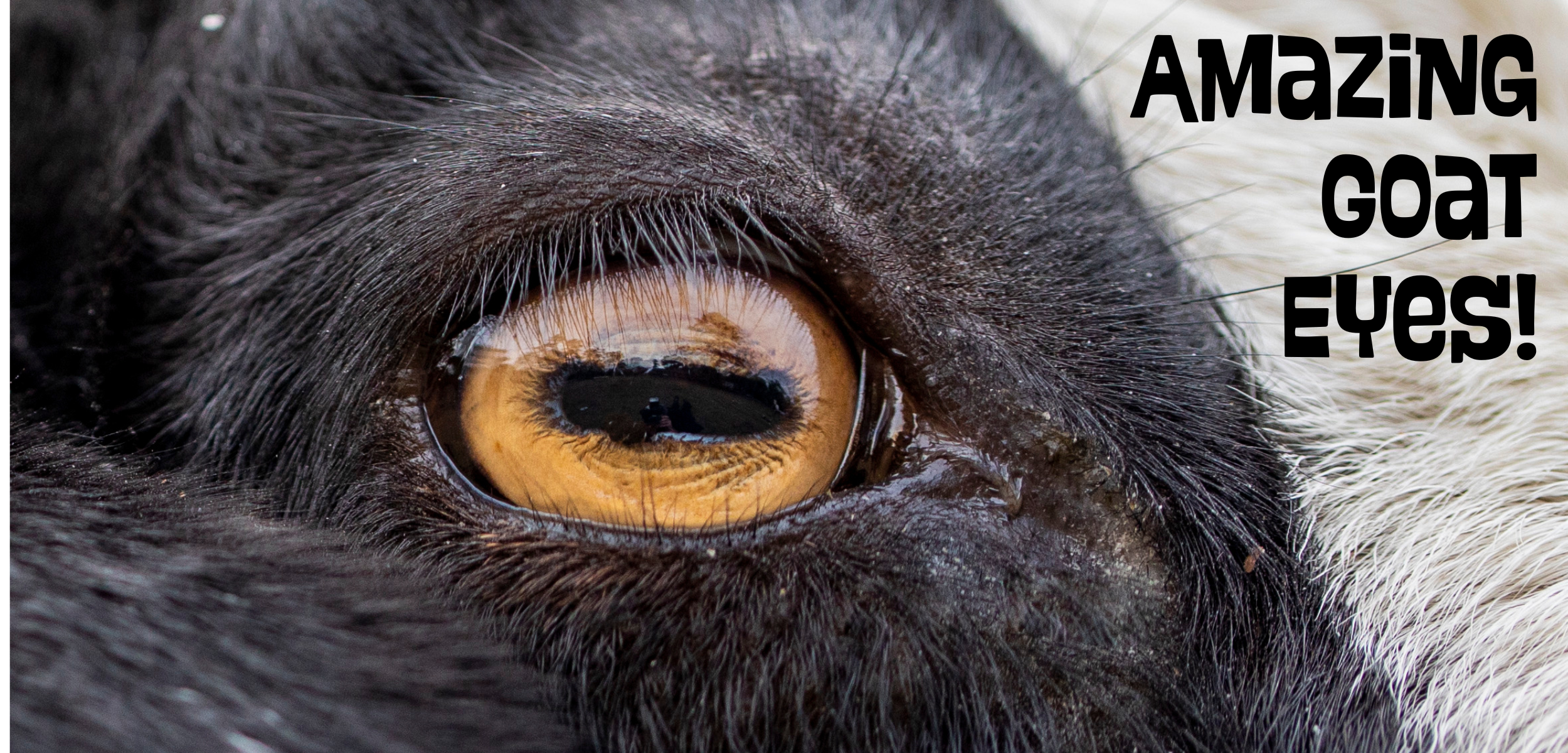
Eyes are often described as windows to the soul, and you can see the mischief, intelligence, and friendliness in the eyes of goats. Compared to human eyes, the most striking difference is the rectangular rather than circular shape of goat pupils. Here are five baaa-riliant facts about goat vision!
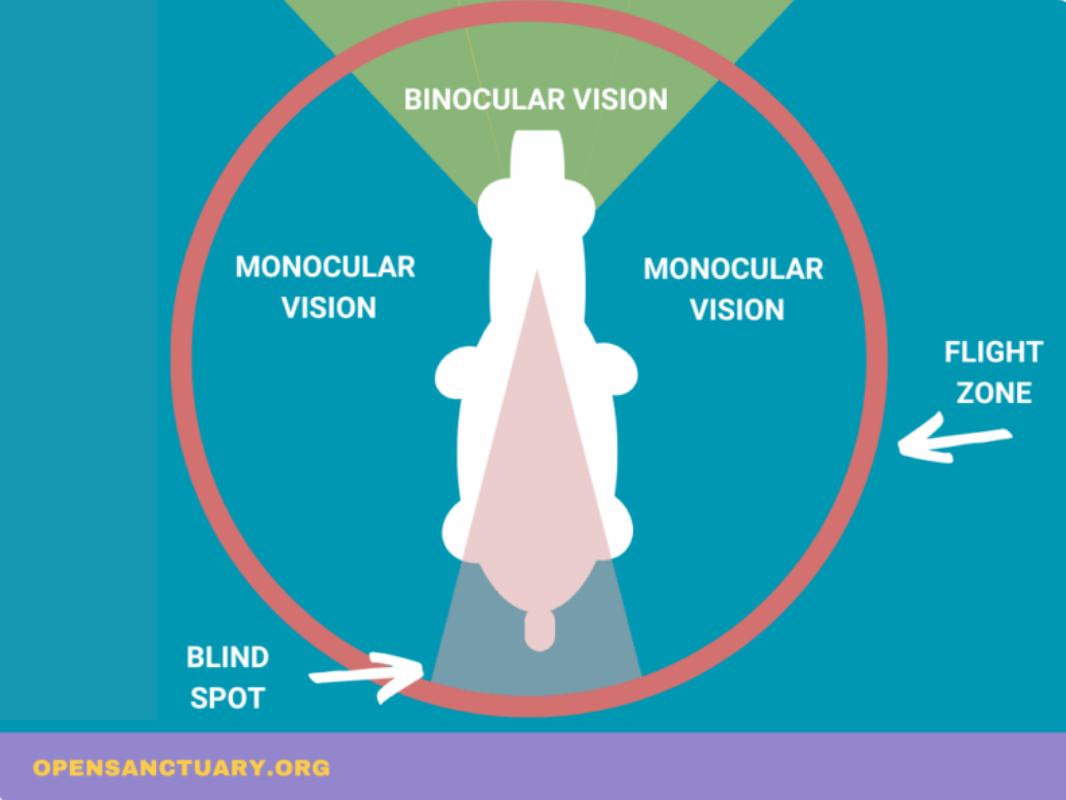
Goats are 340° MOTION DETECTORS
In humans, vision is restricted to 180-200°; we see things in front of us quite well, but we can’t clearly see objects that are directly next to us or behind us. Goats can see almost all the way around their bodies (320-340°) except directly behind them. Amazing!
They have binocular vision where their left and right eye fields of vision overlap in the front (about 20-40°), and monocular vision on the sides all the way back. That means they don’t have great depth perception, but they are really good at detecting the approach of potential predators.
Goats have SHAPE-SHIFTING PUPILS
Goat pupils are rectangular in bright light, which gives them their field of vision super powers, but in the dark and at night, to let in more light, goat pupils will expand, change shape, and become circular.
According to Sarah Yang from UC Berkeley News:
“An analysis of 214 species of land animals shows that a creature’s ecological niche is a strong predictor of pupil shape. Species with pupils that are vertical slits are more likely to be ambush predators that are active both day and night. In contrast, those with horizontally elongated pupils are extremely likely to be plant-eating prey species with eyes on the sides of their heads.”
If you’ve ever looked at a cat’s pupils in bright light, they are vertical slits that change to a round shape in low light as well. Like the aperture on a camera lens capturing a photo in low light, that dilation occurs similarly in both predator and prey.
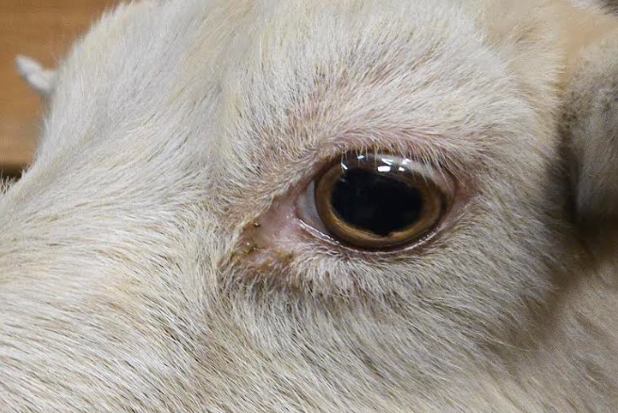
Sassy’s round pupil in low light
Goats have ROTATING EYEBALLS!
The eye is made up of many cell and tissue layers, and iris, or colorful part of the eye, is connected to muscles that open and close the pupil to control the amount of light coming into the eyes. Very bright light can damage sensitive eye tissues; in goats, their rectangular pupils shade the eye from bright sunlight coming from overhead. Goat eyes can rotate 50 degrees or more when their heads are bent down to graze on grass so that their pupil remains horizontal and parallel to the ground. This allows goats to always look out for predators or danger!
Goats see a world of BLUES and YELLOWS
Humans have three kinds of color-detecting cells in the eye that can distinguish between red, green, and blue light. This allows us to see the rainbow spectrum of colors. Goats only have two color-sensing cells that detect green and blue. Without the red-sensing cells, goats see the world in yellows and blues, similar people with red-green color blindness who may perceive reds and greens like shades of tan.

Goat eyes are NIGHT VISION GOGGLES
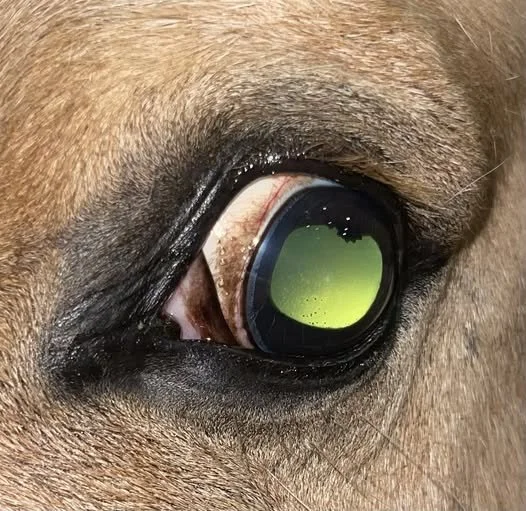
If you’ve ever been spooked by a pair, or many pairs, of glowing eyes staring at you from the darkness, that’s the work of a special reflective layer in the back of the eye that increases the efficiency of light capture. The tapetum lucidum helps to have incredible night vision by reflecting light back into the eye in dark conditions to allow the goats to spot danger at night. The tapetum lucidum is present in many animals, including nocturnal animals, predators, and many herbivores, as well as some fish and reptiles. It causes a bright glow ranging from orange in walleye pike and green in goats, to blue in cats and deer.
The next time you visit the sanctuary, pause and admire the beautiful and soulful eyes of the goats. Please support the care of these incredibly cute and fascinating animals!