
Hay Fever
Contributed by Amy Osajima, Executive Director
What we’ve learned about hay this past year could fill a barn.
First, it might be useful to clarify what we mean when we say “hay”. Hay is not a single crop. Hay is a generic term for grasses and other plants (like orchardgrass, alfalfa, or clover) that have been cut, dried, and bundled into bales to be used as food for animals, especially during winter when pastures freeze and plants are dormant.
If you haven’t spent time around farm animals, you might not know that “hay” and “straw” are not interchangeable. Straw is the byproduct of grain harvesting and does not have much nutritional value, therefore it should not be used as food. The goats will munch on it, but cannot subsist on straw any more than you can subsist on french fries. Straw is, however, optimal for bedding. It is absorbent and because it is hollow, it helps insulate in cold weather. Hay should not be used for bedding because it compacts easily and retains moisture, so it promotes the growth of mold and bacteria.
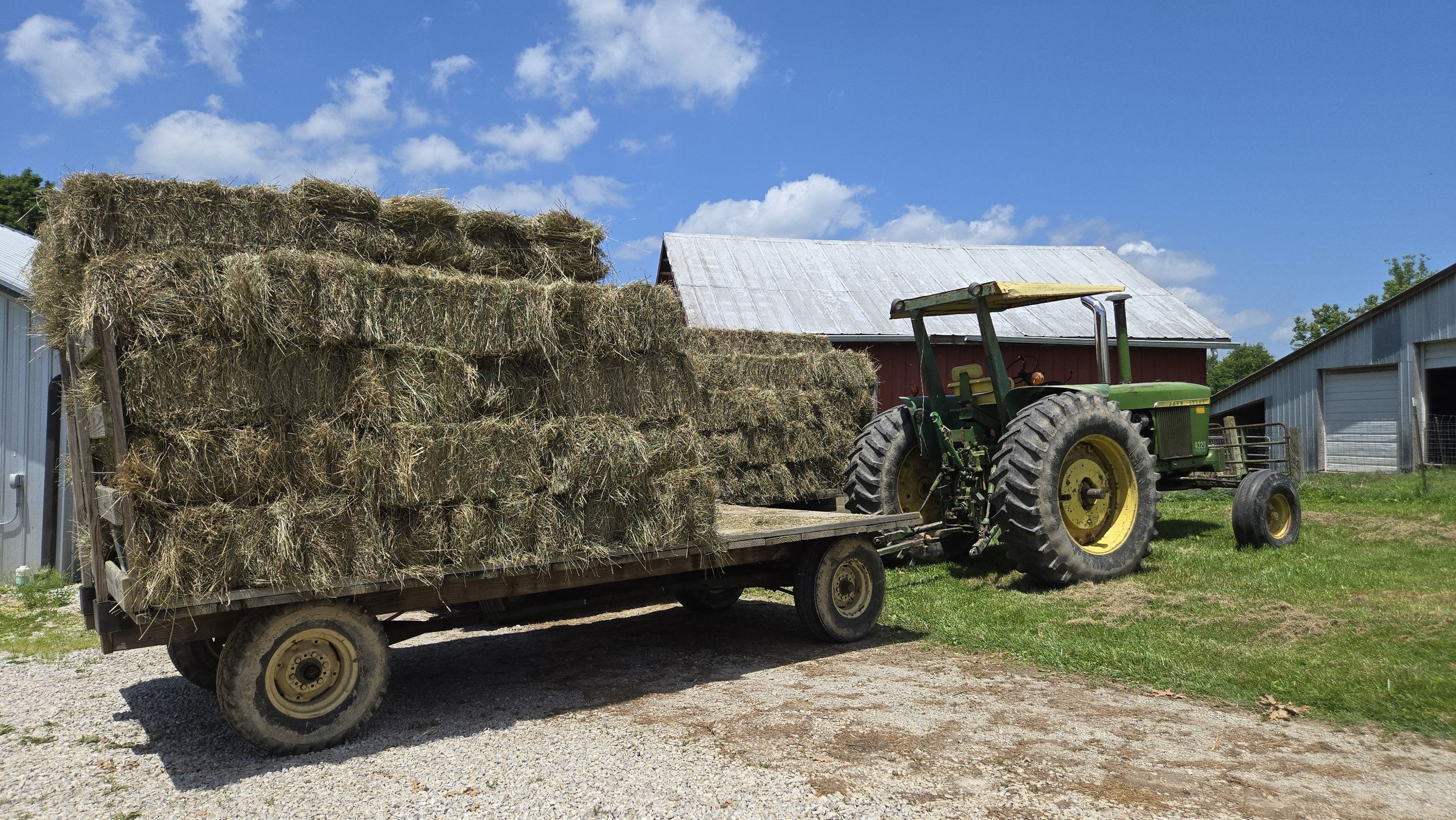
We regularly purchase hay from a local source, but this summer we also cut and baled one of our own fields, which should have provided 1,000 14” x 18” x 36” square bales that would help us get through the winter. What we quickly discovered when we started feeding that hay from our field, unfortunately, was that the goats did not approve. This forage was not up to their standards.
But goats will eat anything, right?
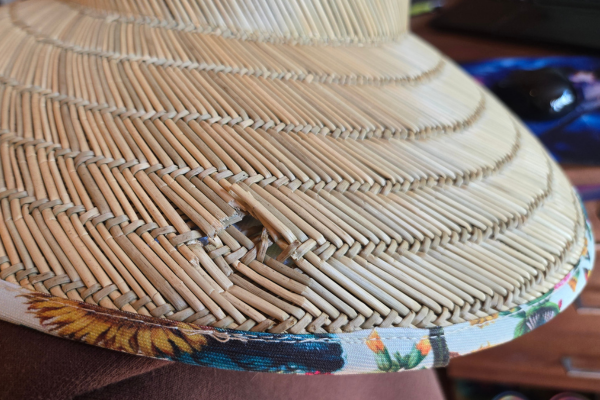
This hat might have been delicious.
Popular lore says that goats will eat anything. We’ve all seen cartoons of goats eating a tin can or nomming laundry off the line, but the truth is that goats are actually pretty picky eaters.
Now it is true that goats will TASTE just about anything. Like the goat who chomped my hat this summer. They wouldn’t want to miss out on a possible delicious snack, so when you visit, they might pull the tab on your jacket, grab your shirt tail or your shoe laces, just in case it could be a tasty treat. Goats are browsers, not grazers, and like toddlers they explore the world with their mouths.
In the case of the forage from our own field, they voted with their mouths, eating only what they liked and leaving the rest in the mangers.
We realized that we needed to bring some science into the process. We got in touch with the Purdue Extension office in Bloomington and borrowed a hay sampling tool — a stainless steel probe that attaches to a drill and is used to extract a core sample from the inside of a hay bale. The serrated tip cuts through the hay, collecting a representative cross-section, which is then sent to a lab for analysis of moisture, protein, and nutrient content.
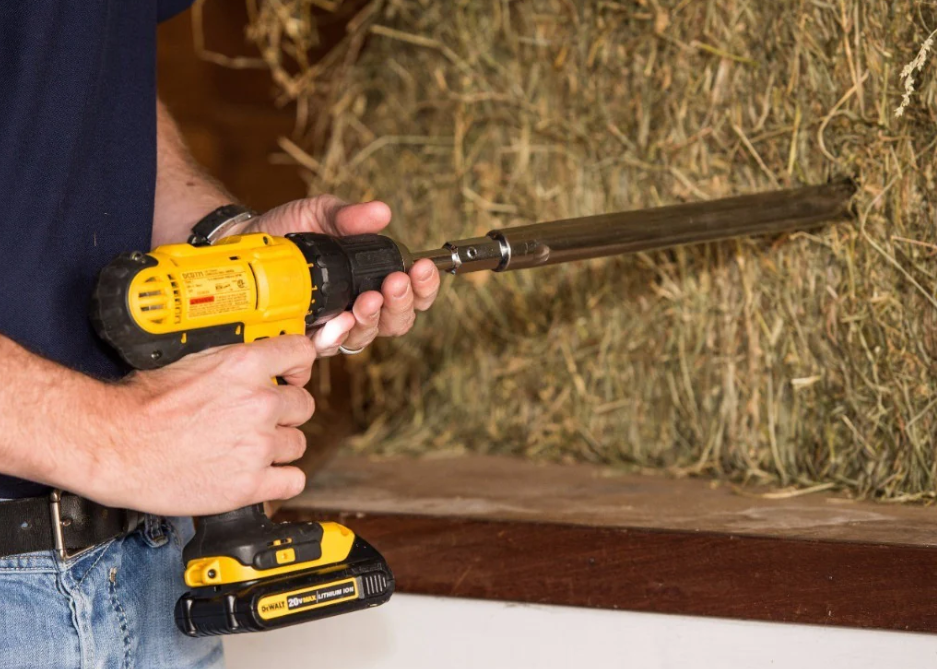
Hay probe sampler attached to electric drill.
What we learned from the results of that hay testing was that the goats were right. The forage from our field was not good. Sigh. But I remembered that a friend that I met at BloomingLabs years ago was a hay farmer, so I reached out to him and he had some large 5-foot round bales available, which he quickly delivered to us. We sent samples of his hay out for analyis, and the results of that test showed almost optimal levels of nutrition.
Getting into the weeds
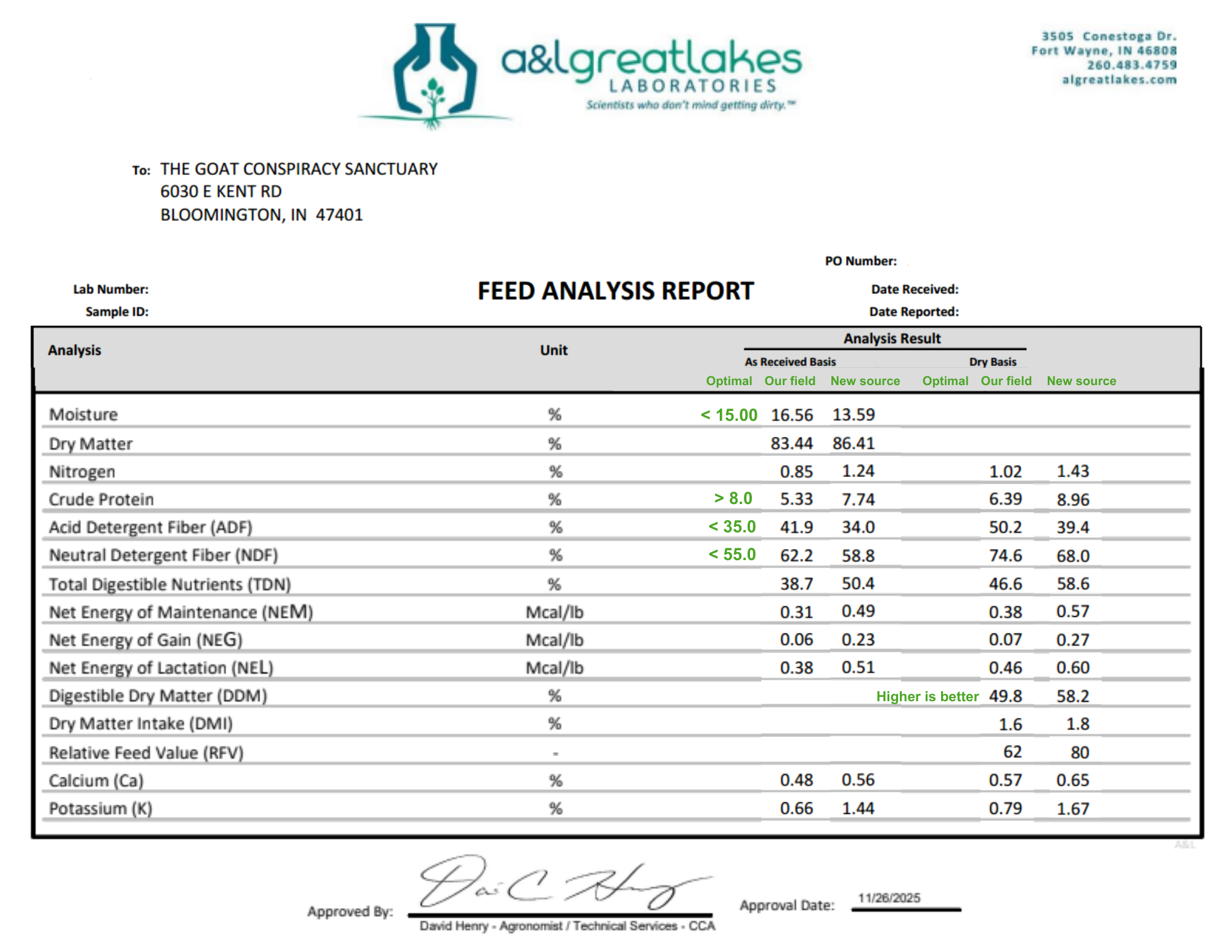
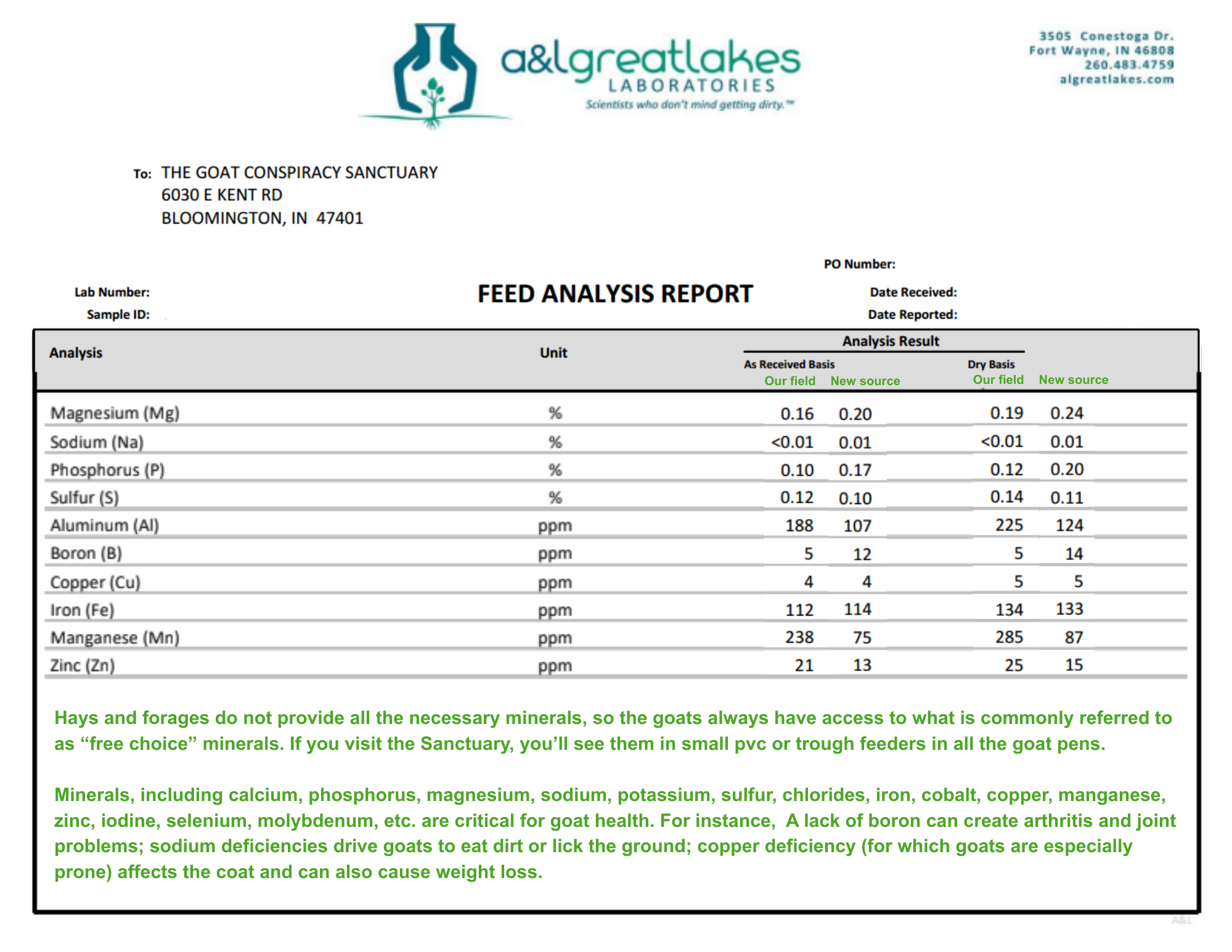
If you want to nerd out over the detailed analysis, the below shows an example of values reported by A&L Great Lakes Laboratories for the samples we sent. I’ve added some key values for optimal percentages vs. the forage from our field and for the hay we subsequently purchased. It turned out that our field just had too many undesirable weeds. Optimal forage contains grasses, including Orchardgrass, Alfalfa, Timothy, Meadow Grass, Fescue, and Clover. What the goats were leaving behind in the mangers was the stemmier parts, after the more desirable leafy hays were consumed.
The below test results list as-fed (as-received) and dry matter (DM) values. Nutrients appear to be higher for DM basis, because all the remaining water (% moisture) in the hay has been factored out. For Crude Protein, values of 8% or greater are usually desired. For Acid Detergent Fiber (ADF), lower is better. The higher the fiber content, the lower the digestibility (even if the protein level is high). Neutral Detergent Fiber (NDF) is the amount of total fiber in the sample, which is typically above 60% for grasses. As ADF and NDF go down, Relative Feed Value (RFV) goes up.
We’re continuing to consult with ruminants experts, including our own Board member, Deborah Blum of Goatlandia in Sebastopol, California, when we have questions about goat health and nutrition. We’ve also reached out to the Purdue Extension office in Brown County, and are looking forward to hearing their advice on both goat health and also how we can turn our own fields into nutritious forage for the future.
Enjoy this time lapse below of filling the loft with hay bales, and come on out to visit the goats, who are very happy with their hay, even if they would very much like to speak with a manager about this weather.
Sources:
https://content.ces.ncsu.edu/forage-quality-concepts-and-practices
https://goatjournal.iamcountryside.com/feed-housing/what-is-the-best-hay-for-goats/
https://extension.oregonstate.edu/catalog/em-8801-understanding-your-forage-test-results
https://extension.psu.edu/determining-forage-quality-understanding-feed-analysis